What does your plan to transition your association’s new leaders into the team after an election look like?

If your answer is, Well, Jim, we have elections…, this article is for you. Even if you do have a plan or checklist you use to changeover your leadership team, please read on. It’s always a good idea to revisit a plan that’s been in place for a while, and I bet you’ll find ideas here to make it even better.
But first, why are we even having this conversation?
Why a Smooth Leadership Team Transition Matters
Associations have elections every year. Every year, you elect a new Board president and vice president, as well as Board members whose terms are up. Every year, those new officers step into their roles and start leading. Pretty straightforward, right?
It may be straightforward, but it leaves out a very important truth: In order for your association to achieve its Vision and Mission, accomplish its strategic priorities and have a positive impact for your members, your industry and your community, you need to have the right leaders with the right tools who can hit the ground running from Day 1. Every day that your new leaders spend learning the ropes is a day they’re not actually leading. You can’t afford to have days or even weeks of that every single year.
That’s why it’s so important to have a leadership team transition plan that:
- Identifies and recruits best-fit candidates—not just warm bodies!—for open positions
- Ensures outgoing leaders have accomplished their goals and transferred their knowledge
- Educates and trains new leaders before they take office
Before we go any further, I need to give this important caveat: Please always refer to and act in accordance with your association’s bylaws, regulations and traditions. If you need help aligning any of the advice I give here with your bylaws, regulations and traditions, please
Now, let’s look at what an effective, productive and smooth leadership team transition looks like.
4 Months Out—Identify and Vet Potential New Leaders
As I talk about in my blog Finding Future Leaders for Your Association—A Fresh Look, leaders don’t materialize out of nowhere. Check out that article for more on developing and supporting your future leaders so that you’ll be ready to identify and vet potential new leaders four months before your annual election.
If you take the steps I lay out in that article, you should already have a good idea of who among your membership is out there and ready to step up. In fact, you will have already begun setting them up to want to move into a more involved leadership position.
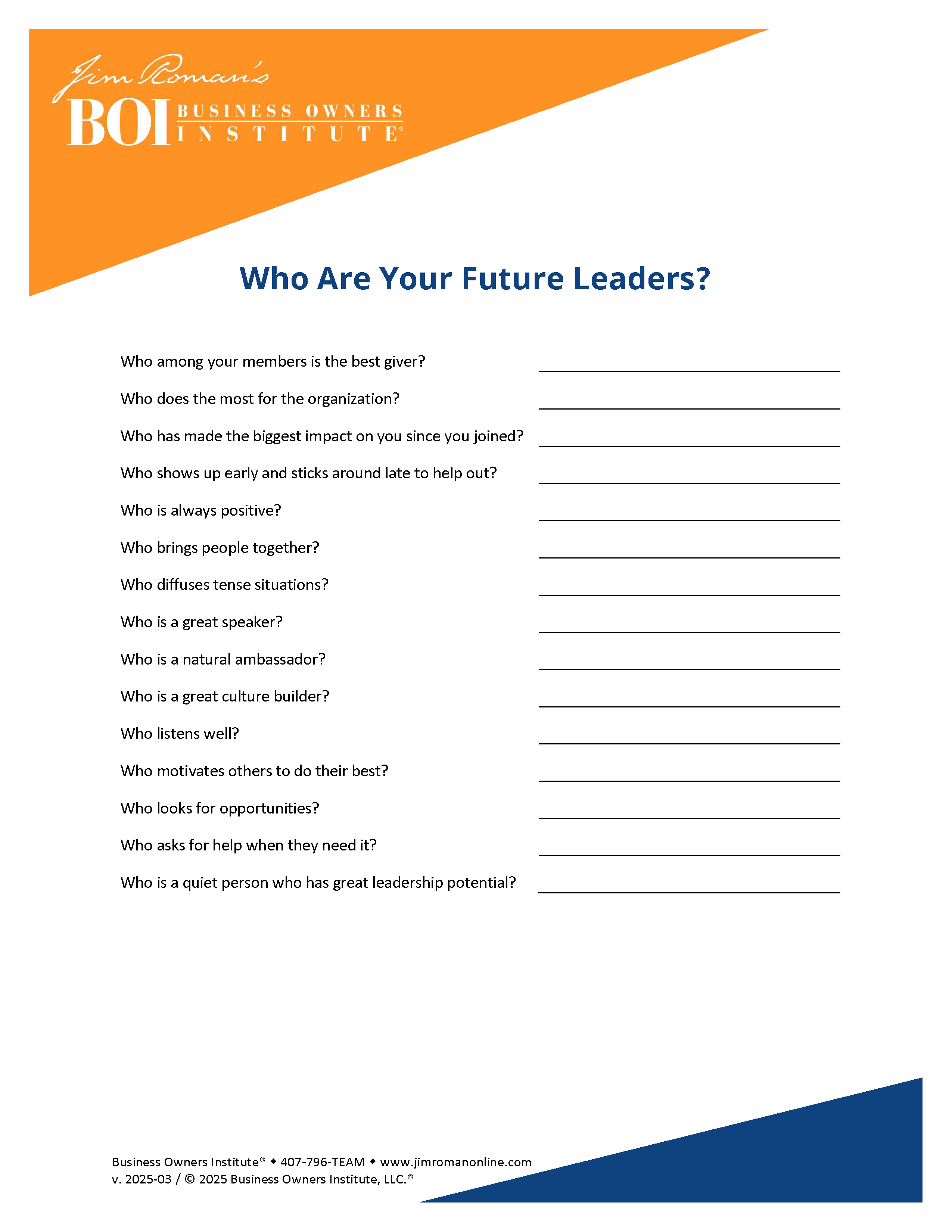
But like they say, two heads are better than one. It’s always a good idea to reach out to your staff, current Board and committee chairs and co-chairs to pick their brains. Ask who they’ve seen volunteering, contributing and stepping up. My Who Are Your Future Leaders? one-sheet helps identify members with strong leadership qualities by asking questions like:
- Who does the most for the organization?
- Who is a great culture builder?
- Who diffuses tense situations?
- Who motivates others to do their best?
After you and your team have a list of potential new leaders, take time to get to know them. Connect with them during meetings and events; invite them out for coffee or lunch. This vetting period is about digging deeper into those leadership qualities you believe they bring to the table, but it’s also about learning more about them as a person.
Not everyone who is a strong leader or has the potential to be a strong leader will be a good fit for your organization. Sometimes there’s a mismatch in culture, values or communication style. There are also times when a mismatch might not be a true mismatch; there are no hard-and-fast rules about when a difference in style will give a leadership team a needed jolt of energy and when it will create unnecessary tension. Before you put someone on the list or write them off, listen to your instincts and get the rest of the current leadership team’s take.
By the end of the month, your goal is to have a list of potential new leaders you want to invite to join the leadership team, and the specific role you want them to take.
Pro Tip: If it seems like a big job to get all that done in one month, you’re right. That’s why I recommend building up a pipeline of future leaders. That blog I referenced earlier, Finding Future Leaders for Your Association—A Fresh Look, walks you through how to do that.
3 Months Out—Prepare for the End of the Term and for Elections
Three months before elections, you have two jobs: to prepare for the current Board president to step away and to finalize your slate of candidates.
Prepare for the Current Board President to Step Away
A lot of people think about transitions in terms of transitioning in to a role. The transition out of a role is just as important: It’s the time to ensure that the current president’s term has been a success for them and the organization.
The best way to do this is for the EO and president to sit down together and take stock. Here are three topics to cover during this meeting:
- The progress the president has made toward their goals and on the strategic priorities they’ve been working on
- Actions the president and EO can take during the final three months to complete those goals or make as much progress as possible toward completing them
- Information and resources that need to be passed on to the next president
I encourage you to set this meeting up for as early in the month as possible, so the president has a full three months to act.
Finalize Your Slate of Candidates

Three months out, you’ll also finalize your slate of candidates by meeting with the potential new leaders you’ve identified and inviting them to serve.
The first step is to let each of them know that you and the current leadership would like them to consider joining the team, and to ask if they would like to learn more. An approach I like goes something like, “Some of the leadership team and I have been talking, and we think you would be great as ___________. Would you be open to having a conversation about serving?”
If their answer is yes, set up a time to share more details, including:
- Why you and the leadership team believe they will make a good leader, and what they bring to the table that will benefit the organization. This is information you can share in that earlier conversation if you get a no from a potential new leader.
- The role itself, including the specific responsibilities and time commitment. Be sure to include the selling points of the role and why it is important.
- Answers to any questions they have.
Once you have your slate of confirmed candidates, present them to the membership and hold elections, in accordance with your bylaws and traditions.
Pro Tip: Despite your best efforts, you may get a hard no from one of your potential new leaders. If that happens, have an alternate candidate ready—and don’t give up on your first choice! Make a plan for how you can turn that no into a yes in the future.
2 Months Out—Prepare Your Newly Elected Leaders to Take Office
You set the transition into office in motion when you laid out the responsibilities and time commitments of the roles to your potential new leaders. Now is the time to give your newly elected leadership team the tools and training they need to succeed in those roles. That includes resources to familiarize themselves with how the association works and the part their role plays in that.

At a minimum, you want to provide:
- Complete job description for their role
- Bylaws
- Strategic Plan
- Association handbook
- Event calendar
You also want to make sure that each incoming leader gets a chance to meet with their outgoing counterpart, maybe halfway through the month. The outgoing leader should hand off any projects they’re working on and share beneficial resources and insider information.
Pro Tip: Keep this positive! Incoming leaders don’t need all the dish on perceived troublemakers or rivalries. There’s a fine line between helpful and toxic.
You also want to continue working on the current president’s transition out of their role. Follow-up with them and the other outgoing leaders, and provide any final support they need to get their projects over the finish line.
1 Month Out—Transition Current and New Leadership
One month out is the time to have final wrap-up meetings with outgoing leadership, and to hold your annual Board training.
Final Wrap-Up Meetings with Outgoing Leaders
Those final wrap-up meetings are just what they sound like: You meet with outgoing leaders for a final review of their projects and to ensure they have transferred ongoing tasks to their new counterpart. Be sure to thank them for their contribution, get their feedback about how they feel things went, and chat about their future with the organization. Even though they’re stepping away from leadership, there are still important contributions they can make.
Annual Board Training
I cannot stress enough how important it is to hold Board training every year!
I’ve worked with associations at all levels, in dozens of industries, for a long time now—twenty-five years!— and I can tell you that holding an effective, well-planned Board training is the single most important thing you can do for your leadership team.
I know that not every Board seat turns over at the same time, and that some Board members will be going through Board training for the second or third time. That’s okay. In fact, it’s great! It’s called a refresher because it keeps us fresh.

You can cover the 5 Keys to Association Success and Board governance best practices every single year, and there will always be something new to talk about: an insight you could only have because of a change in the industry or a new perspective from an incoming leader on a topic that seemed long-settled.
Plus, your strategic priorities are constantly evolving, and Board training is the perfect time to review how well the association accomplished its goals during the past year and what it needs to tackle in the coming year.
Most importantly, Board training is the time to start building a team out of your individual leaders. The relationships you develop during Board training set the tone for the rest of the year. Be intentional about cultivating a culture of connection, communicating and caring.
(For creating a culture of connection in the long-term, check out my blog on the topic.)
Day 1 of New Term—Transition Complete!
This is when you see it all pay off: when your new team of well-trained, motivated leaders hit the ground running to achieve your strategic priorities.
Bringing It All Together to Run a Smooth Leadership Team Transition
By having a plan to identify and recruit best-fit candidates, support outgoing leaders in accomplishing their goals and transferring their knowledge, and educating and training new leaders before they take office, you ensure that you have the right leaders in the right positions with the right tools to take your association to the next level.
You do that by designing a four-month leadership team transition plan that goes beyond elections:
- Four Months Out—Identify and vet potential new leaders.
- Three Months Out—Meet with the current president to prepare for the end of the current term, meet with potential new leaders and finalize your slate of candidates.
- Two Months Out—Post-election, deliver resources to your incoming leadership team to help prepare them for their new role.
- One Month Out—Hold annual Board training and final wrap-up meetings with outgoing leadership to ensure transfer of essential knowledge
Whether your elections are coming up fast or you have some time to plan, I can help.